AI Won’t Replace You, But Someone Using It Might
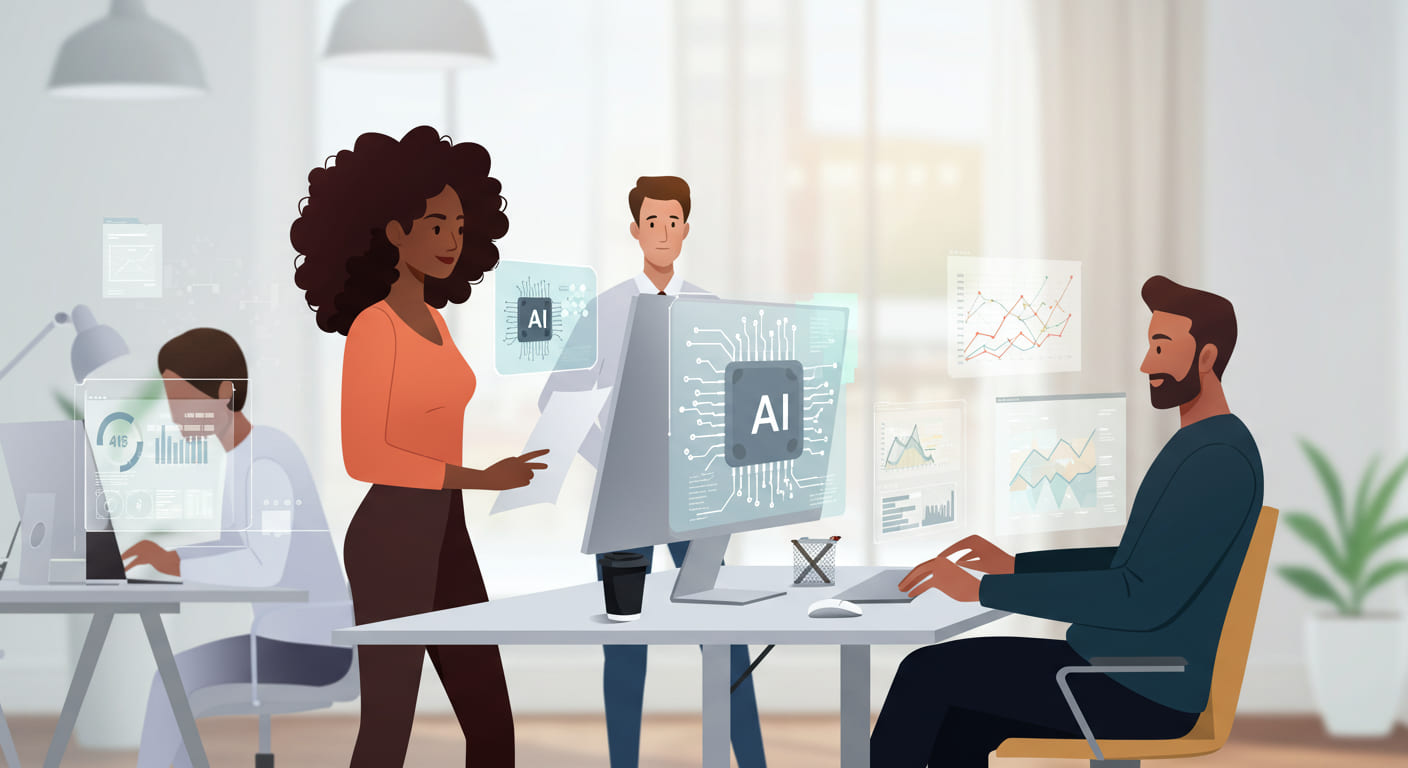
You walk into your Monday morning meeting. You’ve been working all weekend on a pitch deck, carefully researched, polished until 2 AM. Then someone else on your team clicks their laptop, and within seconds, AI has helped them generate an equally polished, maybe even sharper, version of your work. Cheaper. Faster. Smarter. Your boss nods in approval, eyes lighting up. The room shifts. Suddenly, it’s not you being compared to AI, it’s you being compared to the person who knows how to use AI.
That’s the world we’re stepping into. And it’s already here.
The Old Fear vs. The Real Fear
For years, headlines screamed: “Robots are taking our jobs!” The idea was simple: machines would come, and humans would go. A factory worker replaced by a robot arm. A call center worker replaced by a chatbot. A truck driver replaced by self-driving vehicles. But the reality in 2025 looks different. The story isn’t humans versus machines. It’s humans with machines versus humans without them.
A lawyer with AI research tools drafts contracts in minutes. A marketer with AI copywriting writes campaigns ten times faster. A student with AI tutoring learns at double the speed. The gap isn’t about who is “talented” anymore, it’s about who’s augmented.
The Superhuman Effect
Think of AI as an exoskeleton for the mind. Like Iron Man’s suit, it doesn’t replace Tony Stark, it makes him unstoppable. AI won’t turn a bad worker into a genius overnight, but it will give every ambitious, curious, and adaptable person a set of tools that can multiply what they already bring to the table.
This is what economists call a force multiplier.
- The writer who struggled to meet deadlines can now produce content at scale.
- The programmer who knew one language can now debug in five.
- The designer who could only work with Photoshop can now generate concepts in seconds.
It’s not a replacement. It’s acceleration.
Why Adaptability Beats Job Security
The uncomfortable truth is that job security was always an illusion. What mattered, and what still matters, is adaptability. AI just makes the game faster.
Let try to consider this:
- In 1995, typing was a “special skill.” Today, it’s expected.
- In 2005, knowing Excel formulas could make you indispensable. Today, it’s basic.
- In 2025, knowing how to harness AI is already the new baseline.
The winners will be those who don’t just cling to old skills but constantly reframe their roles. If AI drafts your reports, your value shifts to interpretation, judgment, and human connection. If AI designs your ad copy, your edge is in strategy, taste, and vision.
The New Divide: AI-Native vs. AI-Naïve
We’re seeing a new digital divide emerging, not between rich and poor, or educated and uneducated, but between those who are AI-native and those who are AI-naïve.
- AI-Native: Sees AI as an everyday partner. Knows the prompts. Understands how to fact-check. Uses it as naturally as using Google.
- AI-Naïve: Hesitant, skeptical, or unaware. Thinks AI is a gimmick. Uses it once or twice, then abandons it. Still working like it’s 2019.
Which side you fall on could decide your future relevance.
The Human Edge
Now, let’s pause. If AI is so powerful, what’s left for us? Why not let machines do it all? The secret is that AI can simulate, but it cannot originate meaning. It can remix, but it cannot dream. It can recommend, but it cannot care.
What humans bring to the table:
- Context. AI can write you an essay, but it doesn’t know why it matters in this cultural moment.
- Taste. AI can generate art, but it doesn’t know which design makes a client’s heart skip a beat.
- Ethics. AI can analyze data, but it won’t weigh morality unless you teach it to.
- Emotion. AI can mimic empathy, but only humans feel it.
This is your edge. AI amplifies, but it cannot replace what makes you human.
Case Studies: Winners and Losers
The Copywriter Who Thrived
Anna, a freelance copywriter, feared losing clients when AI writing tools exploded. Instead, she leaned in, using AI for first drafts, headlines, and idea generation. Instead of charging per word, she started charging per campaign strategy. She tripled her income in a year.
The Manager Who Faded
Tom, a mid-level manager, dismissed AI as “over-hyped.” He stuck to his old reporting processes. When his company embraced AI dashboards, Tom’s weekly status reports were automated overnight. He wasn’t fired, but he became invisible. His role shrank while others leapt ahead.
The Mindset Shift You Need Now
To survive and thrive, you don’t need to become a coder or AI engineer. You need a mindset shift:
- Curiosity Over Fear. Instead of asking, “Will AI take my job?” ask, “How can AI help me do my job better?”
- Experimentation. Try tools. Break them. Play. Every minute you spend exploring is a future advantage.
- Skill Stacking. Combine human strengths with AI speed. Strategy plus AI equals unbeatable.
- Continuous Learning. Treat AI like a language. The more fluent you become, the more powerful it is.
The Bigger Picture: Society’s Crossroads
On a societal level, the divide between AI-natives and AI-naïves could reshape entire industries:
- Education: Students using AI tutors will learn at exponential speeds. Teachers who embrace it will empower, not compete.
- Healthcare: Doctors using AI diagnostics will outpace those who don’t.
- Law: Firms using AI research will dominate cases faster.
- Media: Journalists who resist AI risk irrelevance in the speed-driven news cycle.
We’re not talking about the distant future. We’re talking about the next two to three years.
What You Can Do Today
You don’t need to overhaul your career overnight. But you do need to start. Here’s a roadmap:
- Pick One Tool. Don’t get overwhelmed. Choose one AI tool in your field and master it.
- Shift Your Value. If AI can automate your tasks, focus on higher-level contributions: judgment, creativity, relationships.
- Collaborate, Don’t Compete. Treat AI as a teammate. Let it handle the routine so you can handle the remarkable.
- Stay Human. Double down on the skills machines can’t replicate: storytelling, empathy, leadership.
The New Frontier
AI won’t replace you. It will sit quietly, waiting for someone to pick it up and wield it. The danger isn’t the algorithm, it’s the person across from you who figured out how to make it sing. In the future of work, the question won’t be: “Will AI take my job?” The real question is: “Am I willing to learn enough to compete with the person who does?”
The future isn’t machine versus human. It’s human versus human, augmented by machine. And the race has already started.